Are churches exempt from payroll tax?
Churches are not broadly exempt from payroll tax, but the rules split sharply by employee type. Non-clergy staff are generally subject to normal FICA withholding, while clergy are treated as self-employed for Social Security and Medicare and pay SECA instead, with no FICA withheld by the church. Most churches, however, are exempt from federal unemployment tax.
Churches are not broadly exempt from payroll tax. Non-clergy staff get standard FICA withholding at the usual 7.65% employer share. Clergy are self-employed for Social Security and Medicare and pay SECA instead, so the church withholds no FICA on ministerial pay. Most churches are exempt from federal unemployment tax. This is not tax advice: confirm your specific situation with a CPA or payroll provider.
Somebody handed you the payroll spreadsheet and said "churches are tax-exempt, so this should be simple." It is not, and this is the post that untangles why, in the order a treasurer actually needs it. It is one piece of what church staff actually costs, and if you have not run the full cost of a hire yet, that guide is the place to start.
The confusion is understandable. Nowhere else does a common phrase, "tax-exempt," mean something so specific and so limited compared to what it sounds like it means. It describes the church's own income, not every dollar that flows through its payroll. Once that distinction is clear, the rest of this stops being confusing and starts being a checklist.
Are churches exempt from payroll tax?
No, not as a blanket rule. "Tax-exempt" describes the church's status under Section 501(c)(3) for income tax purposes. It says nothing on its own about payroll tax, and payroll tax splits two ways: by employee type (clergy versus non-clergy) and by tax type (FICA versus FUTA versus income tax withholding). Get the split right and the rest of this is straightforward.
| Tax | Non-clergy staff | Clergy (ministerial income) |
|---|---|---|
| Social Security & Medicare | Standard FICA, 7.65% employer share | SECA, self-employed, no church withholding |
| Federal income tax | Standard withholding | Withheld only if the minister voluntarily requests it |
| Federal unemployment (FUTA) | Usually exempt for the church | Usually exempt for the church |
FICA rate is a fixed statutory rate (6.2% Social Security + 1.45% Medicare). Clergy tax treatment per IRS Publication 517. Confirm current details with a CPA.
What payroll taxes apply to non-clergy church staff?
Ordinary rules. A church administrator, secretary, bookkeeper, or facilities coordinator gets treated like any other employee at a small employer: the church withholds the employee's share of FICA, pays the employer's matching share of 7.65% (6.2% Social Security plus 1.45% Medicare), and withholds federal and state income tax the same way a small business would. Nothing about the church's tax-exempt status changes this for non-clergy staff.
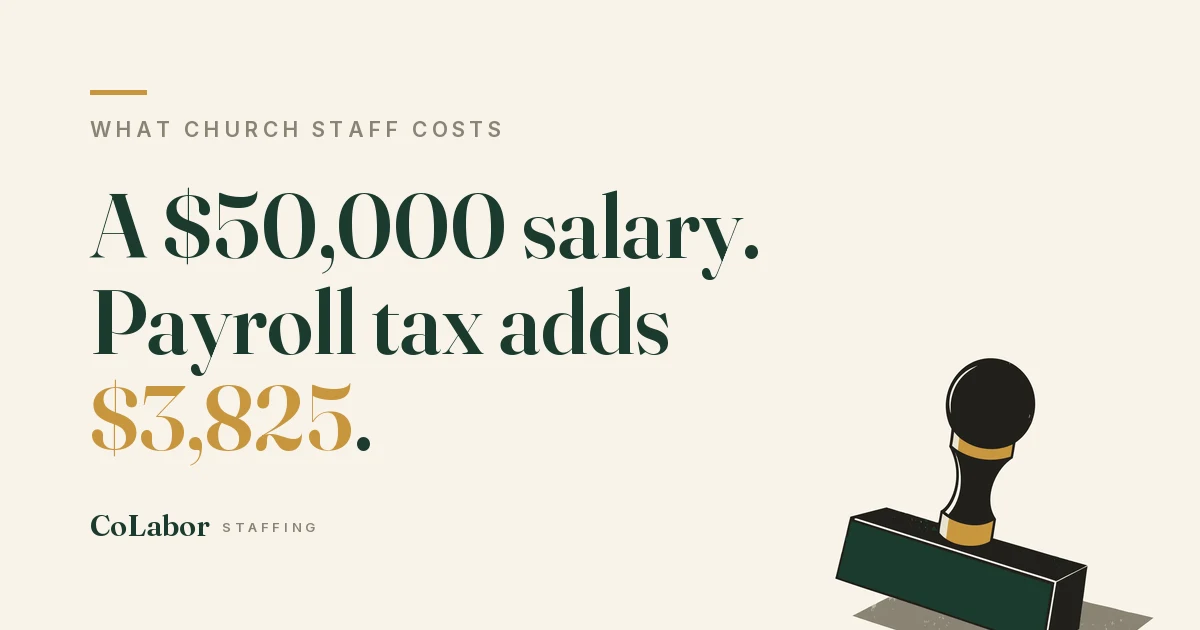
Run the math on a $50,000 non-clergy salary and the employer FICA cost alone is $3,825 a year, on top of the salary itself. That is real, budgetable cost, and it is the same 7.65% whether the employee answers phones, keeps the books, or runs the nursery. It applies up to the annual Social Security wage base, a cap published by the Social Security Administration that changes each year, so confirm the current figure when you run your own numbers.
State income tax withholding follows state rules, not federal ones, and a handful of states have their own quirks around religious employers. If your church operates in more than one state, or an employee works remotely across a state line, that is worth a specific check rather than an assumption.
What is different about clergy payroll tax treatment?
This is the part that trips up first-time church treasurers. Ministers hold a genuinely unusual dual status: they are common-law employees for federal income tax purposes, so they get a W-2, but they are treated as self-employed for Social Security and Medicare purposes. That means a minister pays SECA on ministerial income instead of the church withholding FICA. The church does not pay an employer FICA match on that portion of pay, and does not withhold the employee's FICA share either.
Federal income tax withholding for a minister is also different in one respect: it is voluntary. A minister can ask the church to withhold income tax, or can pay quarterly estimated tax instead. Either way, income tax withholding and Social Security tax treatment are two separate questions, and conflating them is where most of the confusion starts.
Not tax advice
Clergy dual-status tax treatment is genuinely complicated, and edge cases (part-time ministers, non-ordained staff performing ministerial duties, dual-role employees) do not have a one-size answer. IRS Publication 517, "Social Security and Other Information for Members of the Clergy and Religious Workers," is the source to read next. This post explains the general pattern. Confirm your church's specific situation with a CPA before you act on it.
Are churches exempt from unemployment tax?
Most churches and qualified church-controlled organizations are exempt from federal unemployment tax (FUTA). This exemption is broader than the FICA split above: it generally applies regardless of whether the employee is clergy or non-clergy. State unemployment insurance requirements are a separate matter and vary by state, so confirm your state's rule rather than assuming the federal exemption covers it.
Some churches choose to carry state unemployment coverage voluntarily even where they are not required to, as a form of protection for departing staff. That is a policy decision, not a tax obligation, and it belongs in the same conversation as the rest of your benefits package rather than being confused with a compliance requirement.
Where do churches most commonly get this wrong?
Two patterns show up over and over in church payroll audits and CPA reviews:
- Withholding FICA from a minister's ministerial pay. A new bookkeeper, unfamiliar with clergy dual status, runs the pastor's paycheck through the same FICA calculation as everyone else. It has to be unwound, and it is one of the more common errors CPAs who work with churches report seeing.
- Assuming tax-exempt status means no payroll obligations at all. "We're a 501(c)(3)" gets stretched to cover far more than it actually does. Income tax withholding for non-clergy staff, the employer FICA match for non-clergy staff, and state-level obligations all still apply.
- Treating a minister as a 1099 contractor instead of a W-2 employee. Ministerial income tax treatment is unusual, but a minister performing ministerial duties for the church is still generally a common-law employee for income tax purposes, not an independent contractor. Misclassifying the relationship creates a separate problem from the FICA question above.
- Not documenting a minister's voluntary withholding election. Because income tax withholding is optional for ministers, churches sometimes skip the paperwork entirely rather than confirming in writing whether the minister has elected withholding or is paying quarterly estimated tax on their own. An undocumented gap here becomes the minister's problem at tax time, not the church's, but it is an easy thing to get in writing up front.
Once payroll is set up correctly, keeping it that way, running the recurring reports, and tracking board approvals is ongoing administrative work. If that is the piece your office is behind on, running church payroll without the ongoing headache covers the operational side of it in more depth. And if the number that started this whole conversation was "what does a part-time hire actually cost," the real cost of a part-time church admin has the full breakdown, payroll tax included.
CoLabor Staffing places full-time Christian co-laborers with churches and Christian-owned businesses. Getting the tax treatment right is a CPA's job, not a co-laborer's. The recordkeeping, reporting, and administration that keeps payroll running correctly month to month is exactly the kind of work a generalist or bookkeeping specialist handles well.
Confirm it with a professional
This post explains the pattern. Your church's specific situation, especially anything involving clergy dual status, deserves a CPA's or payroll provider's review before you finalize it.
Back to the splitGet the ongoing work off your plate
Once payroll is set up right, running it every month is recurring administrative work. Both prices are published: $1,997 a month for a generalist, $2,997 for a specialist.
See pricingCommon questions
Are churches exempt from payroll tax?
Not broadly. Non-clergy staff are generally subject to normal payroll tax withholding, while clergy have a different, self-employed tax status for Social Security and Medicare.
Do churches withhold FICA from a pastor's pay?
No. Ministers are treated as self-employed for Social Security and Medicare purposes and pay SECA instead. Churches do not withhold FICA on ministerial income.
Are churches exempt from unemployment tax?
Most churches and qualified church-controlled organizations are exempt from federal unemployment tax (FUTA), though state-level unemployment insurance rules can differ and should be confirmed for your state.
What payroll tax mistakes do churches commonly make?
Withholding FICA from a minister's ministerial pay, and assuming general tax-exempt status covers every payroll obligation, are two commonly reported errors.
Is this page tax advice?
No. It explains how the rules generally work. Confirm your specific situation with a CPA or payroll provider before you rely on it.