Part-time or full-time? The math churches usually get wrong
Doubling a part-time employee's hours does not double the cost, because several costs, benefits eligibility, equipment, and management overhead, are fixed per employee rather than scaling with hours. A church moving someone from 20 to 40 hours a week typically sees total cost rise by somewhat more than double the wage alone, largely because crossing 30 hours often triggers benefits eligibility for the first time.
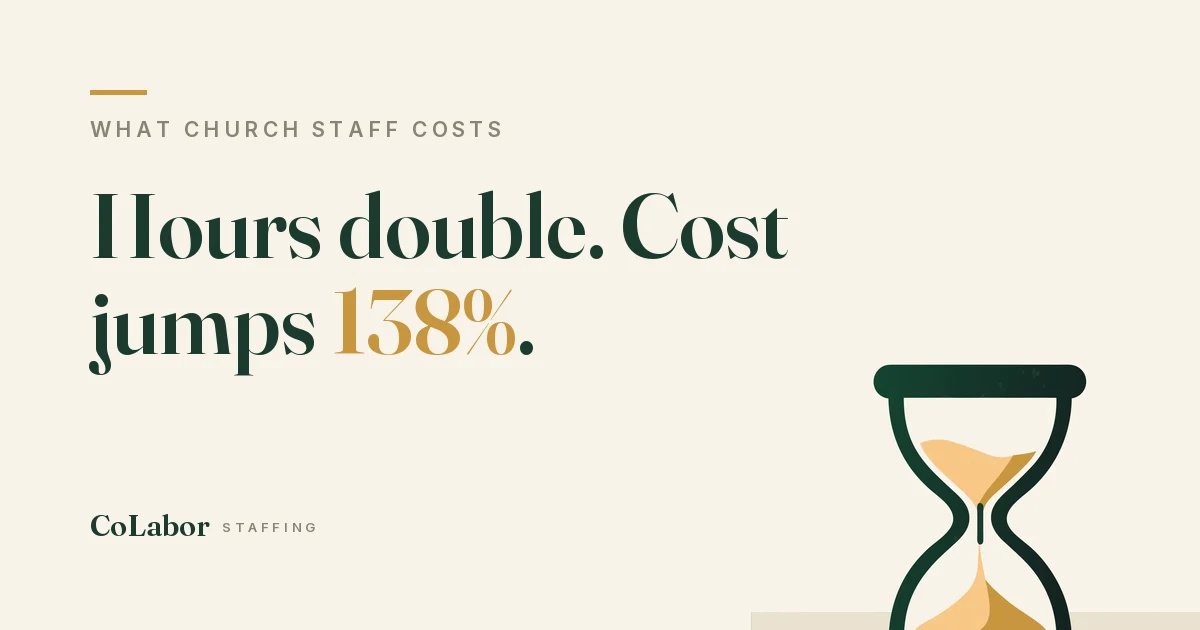
No, full-time does not cost double what part-time costs. It costs more than double, because benefits eligibility, equipment, and management overhead are fixed per employee, not per hour. Moving a role from 20 to 40 hours a week typically pushes total monthly cost from around $2,000 to roughly $4,800, and the biggest jump happens the moment the role crosses 30 hours.
Someone on staff is quietly working closer to 30 hours than the 20 they are budgeted for, and the question keeps coming up: is it time to just make this full-time? The assumption everyone brings into that conversation is that full-time means double the cost. It doesn't, and the reason why matters for the decision. This post is part of our guide to what church staff actually costs.
That assumption isn't unreasonable on its face. Twice the hours sounds like it should mean twice the paycheck, and for the wage line alone, it roughly does. The wage, though, is only one part of what a church actually pays for an employee, and several of the other parts do not move in a straight line with hours worked. Some of them barely move at all until a specific threshold is crossed, and then they jump all at once.
Does full-time really cost double what part-time costs?
No. It costs more than double, and not because of the extra hours themselves. Several real costs attach to an employee once, regardless of their schedule: a laptop, a ChMS seat, the time a manager spends supervising them, and, most significantly, benefits eligibility once a role crosses 30 hours a week. None of those costs are twice as expensive at 40 hours as they are at 20. They are simply present at 40 hours and often absent at 20.
Think of it as two separate kinds of cost stacked on top of each other. One kind scales directly with hours: the wage itself, and the employer payroll tax calculated on it. The other kind is fixed the moment someone becomes an employee at all, and it does not care whether they work 15 hours a week or 40. A church that only budgets the first kind and assumes the second kind will scale down proportionally is the church that gets surprised by the total.
What costs change when a role crosses the 30-hour line?
The Affordable Care Act's employer mandate defines full-time as 30 hours a week or more, and that threshold is the single biggest inflection point in this math. A role under 30 hours generally does not require employer health coverage. A role at 30 hours or more generally does, or the employer faces a penalty for not offering it. Many church retirement plans and PTO accrual policies set their own eligibility lines as well, and those specifics vary by plan document. The pattern holds regardless: below 30 hours, benefits are minimal; at or above it, they become a real, ongoing cost.
This is also why the decision to add a few hours to a part-time role deserves more scrutiny than it usually gets. Bumping someone from 26 hours to 32 looks like a modest, six-hour adjustment on the schedule. On the cost side, it is the difference between a role with essentially no benefits obligation and one that carries a full health-coverage decision. The hours moved a little. The cost category changed entirely.
Side-by-side: 20 hours vs 30 hours vs 40 hours
Using the same $18-an-hour church administrator role and methodology from our part-time cost teardown, here is how the total changes at each threshold. Payroll tax, equipment, PTO coverage, and turnover are folded into the total; benefits eligibility is called out because it is the line that moves the most.
| Hours/week | Wage | Employer FICA | Benefits eligible? | Total, fully loaded |
|---|---|---|---|---|
| 20 | $1,559 | $119 | No | $2,016 |
| 30 | $2,338 | $179 | Yes | $3,218 |
| 40 (full-time, salaried) | $3,955 | $303 | Yes | $4,800 |
20 and 30-hour columns extend the $18/hour, BLS OEWS-anchored methodology from our part-time teardown. The 40-hour column uses a salaried base ($47,460/year, BLS OEWS median), since full-time roles are conventionally paid a salary rather than an hourly wage, matching our full-time cost breakdown. Totals include payroll tax, benefits, equipment, PTO coverage, and turnover; not survey data, illustrative only.
Look at the jump between 20 and 30 hours. Hours go up 50%. Total cost goes up 60%, almost entirely because benefits eligibility switches on. Then look at 30 to 40: hours go up another 33%, and cost goes up 49%, because a role that size is now conventionally salaried and carries a fuller benefits package. Neither jump is proportional to the hours alone, and both run in the same direction: more than the hours would predict.
Run the comparison end to end and the pattern is unmistakable: 20 hours to 40 hours is a doubling of the schedule, but the fully loaded cost moves from roughly $2,016 to roughly $4,800, an increase of 138%. If a board walks into a budget meeting expecting the full-time version of this role to cost exactly double the part-time line, the real number will come in several hundred dollars higher than they planned for, every single month.
When does converting to full-time actually make sense?
Frame it as a workload question first, not a cost question. If a role budgeted at 25 hours is quietly running 35 or 40 unofficially, the honest move is usually not to protect the smaller number on paper. A part-time employee working full-time hours without full-time pay or benefits is a turnover risk in disguise, and replacing them costs more than the gap between the part-time and full-time budget lines ever will. The real question is whether the job in front of you is actually a 20-hour job, a 40-hour job, or something that has grown past both without anyone updating the org chart.
There is a version of this decision that has nothing to do with cost at all. A part-time employee who has been quietly absorbing a full-time load for a year knows it. They also know whether the church has noticed. Formalizing the hours is sometimes the retention decision more than the budget decision, and a board that only runs the dollar comparison misses that half of the picture entirely.
Is there a third option nobody considers?
Yes. A role that genuinely needs full-time hours does not have to mean a traditional full-time local hire, with the full local salary, full local benefits package, and the multi-week search that comes with either one. CoLabor Staffing places full-time Christian co-laborers with churches and Christian-owned businesses, and that option exists specifically for the role that has outgrown "part-time" but where a traditional full-time local hire is not the only path forward. For the fuller version of this comparison, see what it actually costs to hire one employee.
None of this changes the math above. It changes what a church does with the math once it has it. A role that needs 40 hours a week still needs 40 hours a week of work done, competently, by someone accountable to the church. It does not automatically require the full local benefits stack, the multi-week search, and the local salary line that a traditional hire assumes by default.
Recheck your own numbers
Swap your role's actual hourly rate into the table above and see where your own 20/30/40 line sits.
See the table againCompare the third option
If the honest answer is that the role needs full-time hours but not necessarily a traditional full-time local hire, both of our prices are published: $1,997 a month for a generalist, $2,997 for a specialist, 40 hours either way.
See pricingCommon questions
Does full-time cost double what part-time costs?
No. Typically more than double, because several costs, like benefits eligibility, do not scale proportionally with hours.
What changes when a part-time role crosses 30 hours a week?
It often triggers benefits eligibility under the ACA’s full-time definition, along with other plan-specific eligibility thresholds.
When should a church convert a part-time role to full-time?
When the person is already effectively working full-time hours unofficially, since the workload and turnover cost of leaving it part-time on paper often exceeds the cost of formalizing it.
What is considered full-time under the ACA?
30 hours a week or more, under the Affordable Care Act’s employer mandate definition. Church-specific benefit plans may set different eligibility thresholds for other benefits.