What it actually costs a church to hire one employee
A full-time church administrator with a base salary of roughly $47,460 a year typically costs the church closer to $4,800 a month once payroll tax, benefits, equipment, onboarding time, and turnover risk are counted, not the salary figure alone. The same framework applies to any full-time hire; the administrator role is used here because the numbers are well documented.
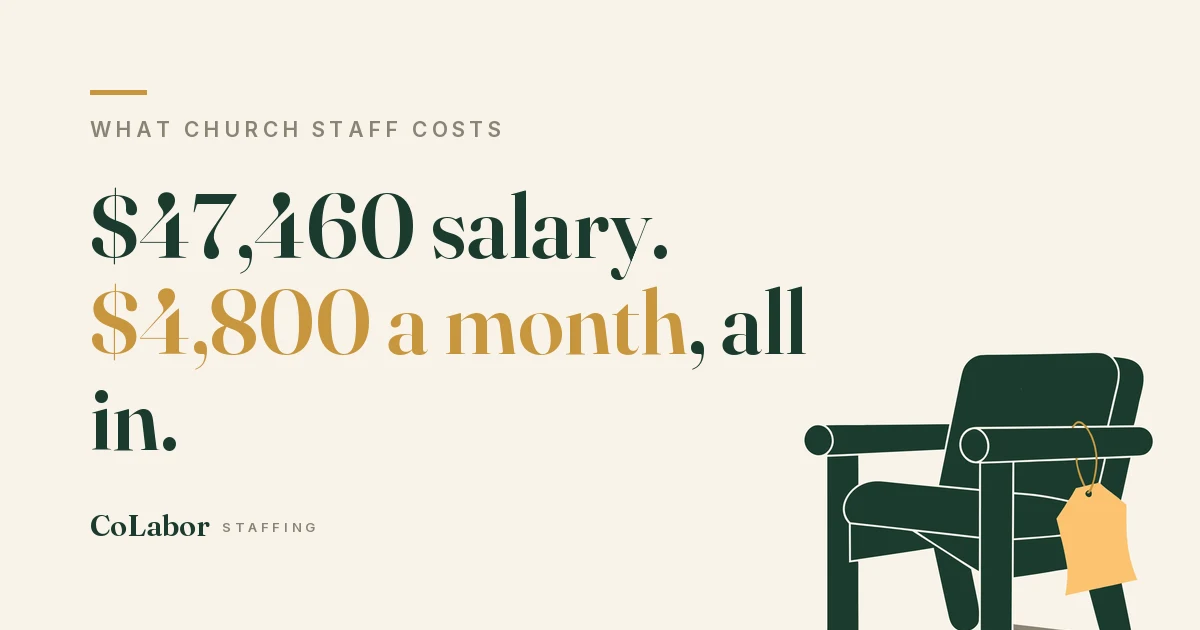
A full-time hire costs a church well beyond the salary on the offer letter. Using a full-time church administrator at a base salary of roughly $47,460 a year as the worked example, the fully loaded cost runs closer to $4,800 a month once payroll tax, benefits, equipment, onboarding, and turnover risk are counted. The same categories apply to any full-time role; only the dollar amounts change.
Somewhere on your desk is a list of things the church needs done and no clear person to do them. Before the conversation turns to a specific role, it is worth understanding the shape of the cost, because "hire someone" always costs more than the number that goes in the budget line. This post is part of our guide to what church staff actually costs, and it lays out the general framework, not just one role's math.
Most of what shows up when you search "cost of hiring an employee" is written for a generic small business, and it treats every hire the same way: salary times a multiplier, done. A church runs a different tax treatment for some staff, a different benefits norm than a typical local employer, and, in most cases, a much smaller HR function running the entire process, often a single office administrator or the executive pastor working the search between everything else on their plate. The framework below is built for that reality, with a real worked example instead of a generic percentage-of-salary rule of thumb.
What goes into the real cost of hiring someone, beyond salary?
None of these categories are unique to churches. What is unique to a church is how thin the margin usually is for absorbing them without a plan, and how often the person running the hiring process is also the one whose calendar has the least room to spare for it. Six categories show up in a fully loaded hire, in every case, regardless of role:
- Employer payroll tax. The statutory FICA rate for non-clergy staff: 7.65% of wages.
- Benefits. Health coverage contribution, retirement match, and PTO accrual, at whatever level the church offers them.
- Equipment and software. A device, a ChMS seat, email and shared drive access.
- Onboarding time. The productivity gap while a new hire learns the role, plus the hours a manager spends training them.
- Management overhead. Ongoing supervision time that a role with no staff didn't previously require.
- Turnover risk. The amortized cost of eventually replacing the person, spread across how long they typically stay.
Notice that only one of these six categories, the salary or wage itself, is the number most churches actually put in the budget. The other five are just as real, and every one of them is paid from the same account whether or not a line was drawn for it in advance.
We already built the fully itemized version of this math for a part-time administrator in the real cost of a part-time church admin. This post takes the same categories and shows what they add up to for a full-time hire, in less granular detail, because the point here is the framework, not the seventh decimal place.
How much does a full-time church administrator cost, all in?
Published full-time salary averages for this role cluster in the high 40s to mid 60s. The Bureau of Labor Statistics' May 2024 OEWS median for the nearest comparable occupation, Secretaries and Administrative Assistants (Except Legal, Medical, and Executive), is $47,460 a year. That number is used here as the base salary assumption because it is the most conservative, broadly sourced figure available; for the full range across sources and by church size, see church administrator salary benchmarks.
| Category | Approx. monthly |
|---|---|
| Base salary ($47,460/yr) | $3,955 |
| Employer payroll tax (FICA, 7.65%) | $303 |
| Benefits, equipment, and software | $257 |
| Onboarding, management overhead, and turnover risk | $285 |
| Total, fully loaded | $4,800 |
Base salary: BLS OEWS, Secretaries and Administrative Assistants (43-6014), May 2024. Payroll tax: statutory federal rate. Benefits, equipment, onboarding, and turnover figures are this post's own conservative estimate by category; the line-by-line math for a part-time version of this same role is in our part-time cost teardown.
$4,800 is not a scare number. It is what shows up on the books once the categories above are counted honestly, and it is the number that should be sitting next to the salary figure when a board approves a new full-time position.
Break the gap between $3,955 and $4,800 down and it stops looking mysterious. Payroll tax is fixed by statute; it is not a judgment call. Benefits, equipment, and software track what the church already offers other full-time staff, so this number should look familiar if you have run payroll for anyone else on staff. The last category, onboarding, management overhead, and turnover risk, is the one worth its own section, because it is the one almost no church budget has a row for at all.
Does the same math apply to every role?
The six categories are constant. The dollar amounts are not. A salaried, exempt role carries different overtime exposure than an hourly, non-exempt one. A specialist role with a longer search and a smaller talent pool carries a heavier turnover line than a generalist role. A worship leader with a housing allowance component runs a different payroll tax calculation entirely. What does not change is that every one of these categories is real for every full-time hire, whether the church budgets for it or not.
This is also why a single "average cost of a hire" figure, the kind most generic HR blogs publish, is not particularly useful for a church. A pastor role, a youth pastor role, and an administrator role differ enough in salary, in benefits norms, and in how hard the position is to fill that a blended average obscures more than it reveals. The framework holds across all of them. The dollar total does not transfer from one role to the next.
For role-specific salary numbers rather than the general framework, see pastor salary by church size and region, youth pastor salary benchmarks, executive pastor salary benchmarks, church administrator salary, and worship leader salary benchmarks.
What about onboarding and ramp time nobody budgets?
This is the category most budgets skip entirely, and it deserves more space than the table above gives it.
SHRM's research on new-hire onboarding is consistent on one point: a new employee is not producing at full capacity from day one, and the gap during that ramp-up period is a real cost, even though no invoice ever arrives for it. It shows up as reduced output, as a manager's hours spent training instead of doing their own job, and as the rework that happens when a new hire gets something wrong before they fully understand the systems. SHRM's own research also shows that structured onboarding measurably shortens this window compared to an ad hoc, learn-as-you-go approach, which is the single most controllable variable in this entire cost category.
Picture the actual first ninety days of a new church administrator. Week one, they are shadowing, learning where things live, and asking questions that take someone else's time to answer. Weeks two through four, they are handling the recurring work, but slower than the person they replaced, and still checking their own work against someone else's. Month two, they start catching things the previous person let slip. Month three, they are running the job the way it was actually meant to be run, not the way they inherited it. None of those months are free, and none of them look like the job description promised on day one.
Why this line gets skipped
Ramp time never appears on an invoice, so it never appears on a budget. That does not make it smaller. It usually means the real cost of the first ninety days is quietly absorbed by whichever staff member is training the new hire, on top of their own job.
The category that sits next to onboarding in the table above, management overhead, is the quieter cousin of the same problem. A role with no direct reports does not require anyone's supervision time. The moment a church adds staff under an existing leader, that leader's week gains a recurring obligation: one-on-ones, course correction, and the accountability that keeps the new hire's work aligned with the church's actual priorities. That time is not wasted. It is also not free, and it belongs in the same conversation as the salary line, even though almost no church budget process puts it there.
Full-time or part-time: does the math change the decision?
Often, yes, and not in the direction most churches assume. Doubling a part-time role's hours does not double its cost, because several of the six categories above, equipment, software, and often benefits eligibility, are fixed per employee rather than per hour. A church that assumes going from 20 hours to 40 simply doubles the number is usually surprised, and not pleasantly, by the actual comparison. The full breakdown, with a side-by-side table at 20, 30, and 40 hours, is in part-time or full-time: the math.
That comparison matters most at the exact moment a church is deciding whether to add hours to an existing part-time role or bring on a new full-time position from scratch. Running the six categories against both options, honestly, before either decision gets made, is the difference between a budget that holds up in the following year's meeting and one that quietly runs over again.
CoLabor Staffing places full-time Christian co-laborers with churches and Christian-owned businesses. Once the real cost of a hire is on the table, that comparison is worth running before a job goes up on a board.
Run the framework yourself
Swap your own role's salary and benefits level into the six categories above. The framework holds regardless of the role.
See the worked exampleCompare against a co-laborer
Once the real cost of a hire is on the table, it is worth comparing it to the two numbers that do not move: a generalist co-laborer at $1,997 a month, a specialist at $2,997. Both prices are published.
See pricingCommon questions
What does it actually cost to hire an employee at a church?
Typically well beyond the salary figure once payroll tax, benefits, equipment, onboarding time, and turnover risk are counted. A full-time church administrator, for example, runs roughly $4,800 a month fully loaded.
What costs get missed when budgeting a new hire?
Onboarding and ramp-time productivity loss, turnover risk, and the value of the hours spent running the search itself are the three most commonly missed categories.
Is the true cost of an employee the same for every role?
The categories are consistent, but the dollar amounts shift by role, by whether it is salaried or hourly, and by exemption status.
How long does it take a new hire to become fully productive?
It varies by role, but SHRM research on ramp-up periods shows structured onboarding cuts the time to full productivity substantially compared to an ad hoc first few months, which is where most of this cost hides.